

Summary
Industry: Cloud & IT Services
Date: 9th September 2025
Executive Summary
A global cloud and IT services provider engaged SAMexpert to defend one of its subsidiaries against a high-stakes Microsoft SPLA audit. Initial audit findings indicated multi-million exposure, but through detailed analysis, risk modelling, and a robust negotiation strategy, SAMexpert successfully reduced the exposure by more than 70%, avoiding severe financial penalties.


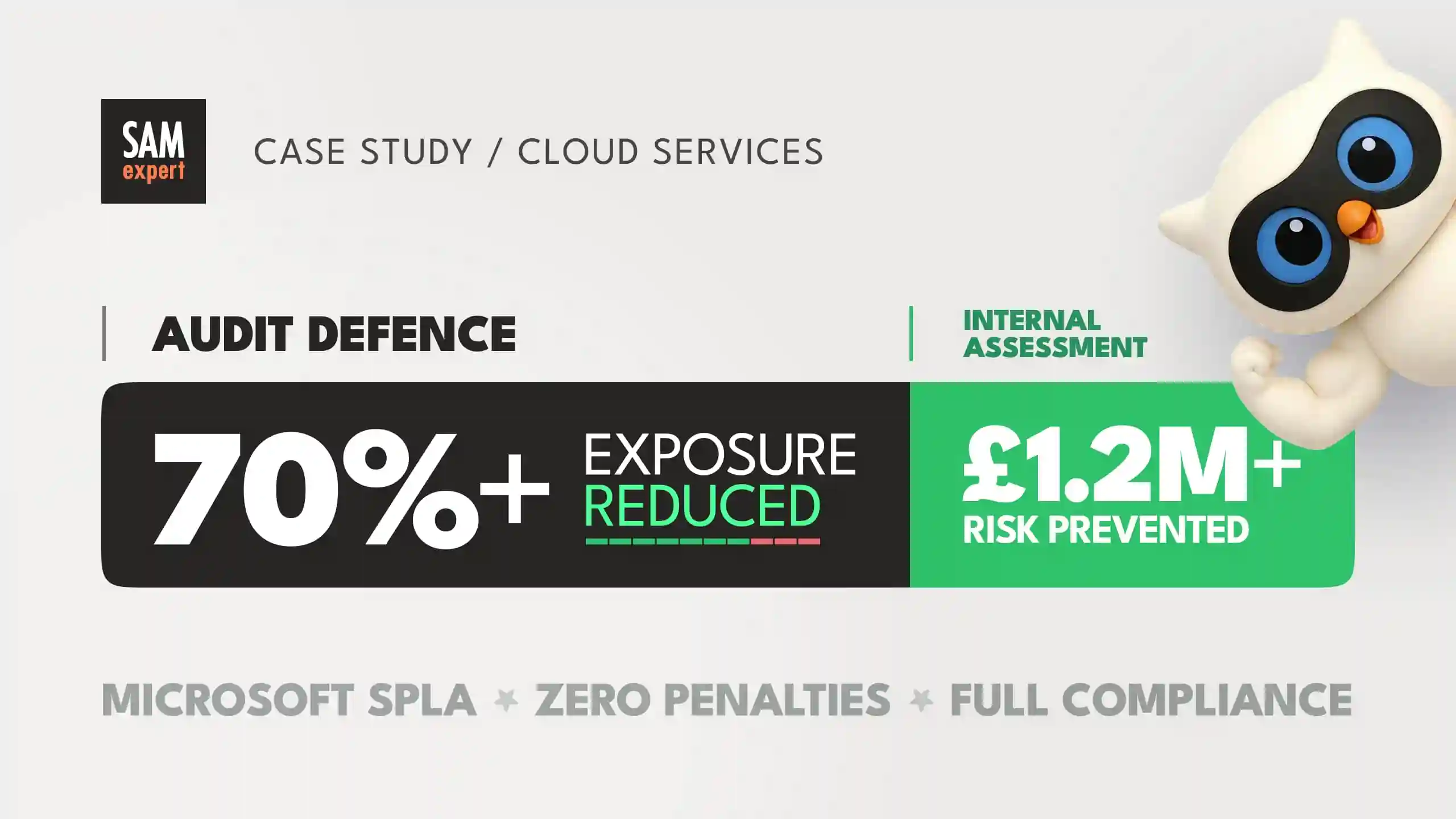
Following the success of this engagement, the client commissioned SAMexpert to perform a proactive SPLA compliance assessment across its wider infrastructure. This internal review validated a strong licensing posture, identified targeted improvements, and mitigated potential risks valued at seven figures under worst-case audit assumptions.
Together, these projects delivered significant cost avoidance, strengthened governance, and enhanced audit readiness.
Client Profile
Industry: Cloud & IT Services (UK and international operations)
Operations: Global cloud and managed services infrastructure
Engagements: Microsoft SPLA Audit Defence, Internal SPLA Risk Assessment
The Scope
Audit Defence. Faced with an official Microsoft SPLA audit, the client required a pre-submission risk assessment, validation of data and contractual scope, challenge of auditor assumptions and Effective License Position (ELP), and development of a strategic negotiation plan.
Internal SPLA Risk Assessment. Following the audit defence, the client commissioned SAMexpert to conduct a "mock audit" of its broader SPLA infrastructure, quantify both best- and worst-case compliance positions, identify cost-avoidance and risk-reduction opportunities, and provide recommendations to strengthen governance and audit readiness.
The SAMexpert Approach
Phase 1: Baseline Risk Assessment (Audit)
SAMexpert performed a comprehensive risk assessment before data submission:
Reviewed contracts, SPLA terms, and reporting history
Analysed system deployments and data integrity
Modelled potential exposure scenarios, both best- and worst-case
Phase 2: Data Validation and Auditor Engagement
Ensured all data packets were validated, cleansed, and defensible before submission
Identified anomalies, including decommissioned environments and misaligned onboarding timelines
Produced explanatory documentation to pre-empt auditor challenges
Phase 3: ELP Challenge
When the auditor issued their draft ELP, SAMexpert conducted a deep-dive analysis to identify misinterpretations, introduced overlooked surpluses and exclusions to offset shortfalls, coordinated multiple iterations of rebuttals and supporting evidence, and ensured the final ELP accurately reflected the client's actual licensing position.
Phase 4: Negotiation Strategy
A three-tiered negotiation strategy was developed. Disruption: challenging audit assumptions and highlighting Microsoft enablement failures. Alignment: positioning the client as a partner open to future licensing evolution. Timing: leveraging fiscal deadlines and audit fatigue for concessions.
Phase 5: Internal SPLA Risk Assessment (Group Infrastructure)
Conducted a mock SPLA audit replicating Microsoft's methodology
Reviewed every month between January 2019 and November 2023
Identified low-level compliance gaps with best-case deficit <£7K
Highlighted potential worst-case risks >£1.2M if auditors assumed different technical interpretations
Provided practical recommendations to reduce risk and improve data evidence collection
Results & Financial Impact
Phase | Challenge | Outcome |
|---|---|---|
SPLA Audit Defence | Multi-million initial exposure | Exposure reduced by 70%+; several million in avoided penalties |
Internal SPLA Assessment | Potential £1.2M+ worst-case exposure | Compliance confirmed within tolerance (<5%); worst-case risk avoided |
Deliverables
Full Baseline Risk Assessment
Data validation and defensible audit submissions
ELP rebuttals and protocol of disagreements
Strategic negotiation framework
Mock audit report and recommendations for the Group infrastructure
Long-Term Value
Cost Avoidance → Multi-million financial exposure neutralised through audit defence and proactive risk assessment.
Risk Mitigation → Identified and addressed potential audit weaknesses before they could become liabilities.
Operational Continuity → Ensured no disruption to business operations during audit defence.
Audit Readiness → Enhanced governance and compliance maturity across the organisation.
Trusted Partnership → Initial audit defence success led to a follow-on engagement and ongoing advisory role.
Conclusion
This engagement demonstrates the value of combining proactive risk modelling, meticulous validation, and strategic negotiation. SAMexpert enabled the client to successfully defend against an aggressive Microsoft SPLA audit, then leveraged that success to drive an internal review that reinforced the compliance posture. Together, these projects delivered substantial cost avoidance, stronger governance, and positioned the client to move forward with confidence.